The Hair on My Pillow
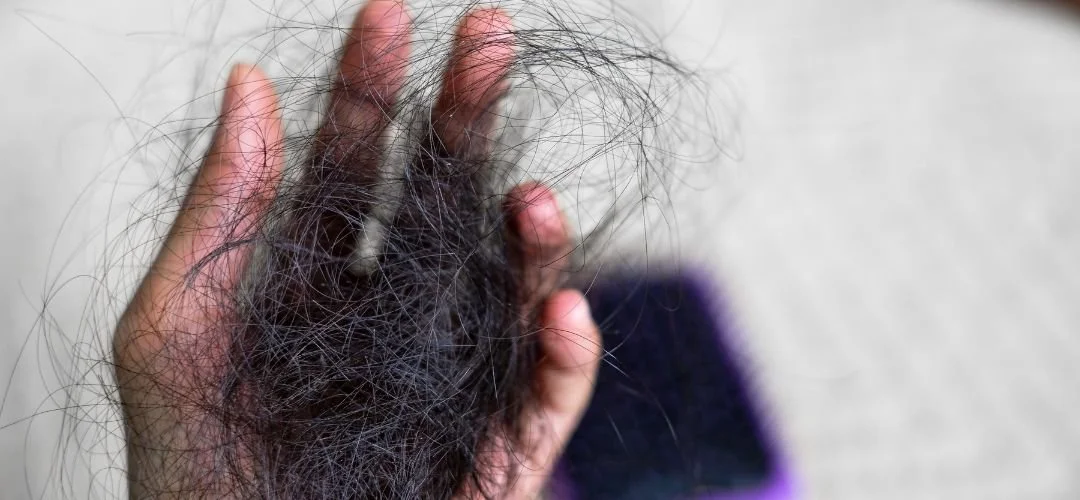
For me, it was the pillow. I was making my bed, eyes still blurry from sleep, and noticed brown streaks on my white pillowcase. Damn dogs must have gotten dirt on the bed again, I thought. I tried to brush it away, knowing I should just change it but pressed for time. A few strands of hair met my palm.
I dismissed this and moved on with my day. One week later, the shower water would not drain and the water level climbed over my feet. My husband had just cleaned the drain a few weeks prior for the same reason.
When he got home from work that evening, I asked him to clean the shower drain again. That’s when he shared with me that he had been having to do this weekly and was keeping the Drano under his sink.
I had always had thin, fine hair and for the past few months I had been too busy running my Dermatology practice to really think about my hair. I had even gotten tape-in extensions, telling myself that I just wanted it to be a bit thicker. But that narrative didn’t quite ring true.
Then one day, the extensions fell out, pulling out the hairs they were adhered to at the root. I had linear bald patches on both sides of my head.
Then the hair appeared on my pillow, and I realized that the shower drain had been trying to fill me in on my issue as my scalp filled it with hair.
My heart raced with the recognition of a sign almost missed. This reminded me of when, at age 12, my forever skinny frame dropped 20 pounds and we didn’t even consider this was a sign of Type 1 Diabetes because I had always been so small.
Once again, a medical issue was hiding from me in plain sight.
I’m a board-certified dermatologist. I examine women’s scalps and discuss hair loss with them every day. I tell them they aren’t crazy, that it’s not in their heads, it’s on their heads. And yet I found myself in the same thought spiral — I can’t be losing my hair. I must just be stressed. I don’t have time for something to be wrong.
I was also still drinking alcohol at that time — it was vegan, after all — and I had been blaming most of my symptoms on that.
I was actually very fortunate in piecing together the multiple factors causing my telogen effluvium. As for most women, my hair loss was due to a mix of factors. My ferritin was around 13, indicating insufficient iron stores from my plant-based diet and my crime scene perimenopausal menses. My stress level was at an all time high with the demands of practice ownership, patient care, and parenthood pulling me in every direction with no time to unwind. My hormones were certainly shifting, and I was regularly waking up at 3am drenched in sweat.
I wish I could tell you I addressed all of this and turned things around in a matter of weeks, or even months. But just as the factors leading to my hair loss had accumulated to critical mass over time, I would find that the undoing and correction would take almost a year and require changes in almost every aspect of my life.
Just over a year later, with most of my hair back and my life rebuilt with this new knowledge, I encourage you to believe this if nothing else.
If you’re a woman in your 40s or 50s, noticing more shedding, a widening part, or overall thinning, you are not imagining it.
But here’s the part I want you to understand:
Just because it’s common does not mean it’s something you have to accept.
This is a physiologic signal. And like many of the changes we experience in midlife, it’s rooted in biology, not randomness.
And it’s not your fault. Let’s dive deeper.
What’s Driving Hair Loss in Midlife
Hair follicles are incredibly sensitive to change.
And perimenopause is a time of constant change.
1. Estrogen Decline
As estrogen levels drop, the hair growth phase (anagen phase) shortens. Hair does not grow as long, it shifts into shedding phase sooner, and gradually, the density declines.
My patients share with me: “I see more of my part line than I used to,” or “my ponytail is half as thick as it used to be.” Whether their hair has always been thick or forever fine and thin, they notice these changes.
I’m often the first doctor to ever stop and talk with them about perimenopause. The conversation travels from hair loss to hot flashes, brain fog, changes in libido, disruptions in menstrual cycles. Lightbulbs go off, and the spotlight on hormone shift shine bright.
2. Relative Androgen Activity (DHT)
As estrogen becomes erratic in perimenopause, we talk about androgens and the new role testosterone plays in the hair loss process.
I am very clear with my patients that most of the time, it’s not that testosterone is suddenly “high.” It’s that estrogen is no longer consistently balancing it, and testosterone’s activity at the hair follicle has lost consistent suppression.
In follicles that are genetically susceptible, this allows more conversion to DHT (dihydrotestosterone). DHT shrinks the follicle over time, producing finer, weaker hairs. Eventually, the hair can stop growing altogether.
3. Stress + Sleep Disruption
Sleep disruption in midlife compounds the problem. Whether the sleep disruption is from fluctuation progesterone and estrogen levels, that nightly glass or 2 of wine, or 3am flash-mob committee meetings in your head about your aging parents and pubertal kids, sleep doesn’t come or stay easily for many women in this phase.
Stress soars. Cortisol climbs. The hair reacts.
Hair follicles, being metabolically active, respond quickly to both physical and emotional stressors.
Another medical snow-ball effect emerges. Losing sleep over hair loss can actually make your hair loss worse.
The Two Most Common Types of Hair Loss I See
I’ve referenced my own telogen effluvium, so let’s get into the most common types of hair loss I see in women. And yes, they often occur together.
Female Pattern Hair Loss
This is hormonally driven and very common in perimenopause. The text books will tell you it’s mostly impacts the midline part and it’s driven primarily by heightened androgen activity in the hair follicles. I’ll tell you that it rarely exists in pure androgen-driven format in midlife women.
What I hear from women is that they are gradually seeing more of their scalp than they used to. They may not notice increased shedding, they just notice they have less hair.
Female pattern hair loss can occasionally point to something more — a true androgen-excess disorder like polycystic ovarian syndrome, congenital adrenal hyperplasia, or rarely, adrenal tumors. If hair loss appears alongside other signs of androgen excess like hormonal acne or hirsutism (male-patterned facial or body hair), a full workup is warranted and beyond the scope of this piece.scope of this piece.
Telogen Effluvium (Shedding)
Either alongside or separate from Female Pattern Hair Loss, is telogen effluvium. This is the premature transition of a larger percentage of hairs out of the healthy growing anagen phase into the resting or telogen phase.
These patients say “My hair is coming out by the fistfuls,” or “I am constantly finding hairs all over my clothing.”
Or perhaps, like me, they can’t seem to keep the shower drain draining.
Telogen effluvium can be elusive in that it usually lags 2-3 months in onset behind the physical or emotional stressor that triggered it. By the time the hair loss manifests, women think they are well on the other side of whatever adverse situation they had faced.
Common triggers include hormone shifts including post-partum hair loss, going on or off hormonal birth control, and hormone transitions during perimenopause.
Illness, surgery, rapid weight loss either with or without GLP1s on board can trigger telogen effluvium.
Divorce, challenges with caring for parents or children, or just treading the midlife waters to stay afloat can ultimately result in telogen effluvium.
And yes, you can have both happening at the same time. The female pattern hair loss is often more subtle, and it’s the overlying telogen effluvium that unmasks it.
The Labs I Check
When I evaluate hair loss, I’m not ordering everything under the sun. I focus on what evidence supports could be at play and has an actionable plan if abnormal.
Ferritin levels are the most common issue I find in my female hair loss patients. Ferritin is a measure of iron stores. A woman can have insufficient ferritin and not have iron deficiency anemia. In the battle for iron, the blood cells and need to oxygenate our bodies will win out over our hair’s iron needs every time. That’s smart evolution. But we can do better.
The exact levels are not carved in evidence-based stone, but most dermatologists agree that maintaining a ferritin level over 40 will support hair growth. Many of us aim higher — toward 70 or above. Since the “normal range” at most labs has a floor of 10, this is not something that will be flagged. Your dermatologist has to check it and know it. And if it’s under 40, iron supplementation can correct this in many cases.
Vitamin D is another lab I check. There is less causative data around low Vitamin D and hair loss, but many women with hair loss are Vitamin D deficient. It’s checkable and fixable with supplementation. As a sunscreen advocate, I also regularly inquire about my patients’ Vitamin D levels as we prefer supplementation over sun exposure to maintain healthy levels.
I also order thyroid panels with regularity. Thyroid dysfunction, both hyper and hypo, are very common in midlife women, and hair loss is common symptom of both.
These are high-yield and correctable.
What Actually Works (and What Doesn’t)
Treatments with Real Evidence
Minoxidil works. Yes, that’s the stuff in Rogaine. And no, you don’t need a prescription for the topical.
Women hate being told to just use Rogaine. It’s sticky and messy, and if you don’t wash your hair every morning, it may change the way your hair looks the next day.
I prescribed a lot of low dose oral minoxidil for this reason. It’s an easy pill to swallow, is generally well tolerated, and doesn’t make a mess.
Topically or orally, minoxidil works in several ways we understand and others that we don’t. It stimulates blood flow, prolongs the anagen growth phase, and increases the size of the hair follicles. It does not directly impact hormones, an important consideration for many women, although it does help hormonally driven hair loss.
Minoxidil grows hair, and it doesn’t care where. Personally, I was thrilled when my 9 year old pointed out my dark new facial hair in a grocery store recently. If it’s growing on my face, it’s growing on my head. That’s not a celebratory discovery for every woman, and it’s key to know that possibility going into this treatment.
Minoxidil can also cause the “dread shed,” the increased hair shedding that strikes within the first 4-8 weeks of starting it. The new healthy hairs push the old stragglers out. They were going to go anyway, it just happens faster. Ultimately a sign of new growth and improvement, it can terrify women into to stopping the minoxidil abruptly if not warned.
Spironolactone
Spironolactone is another cardiology-turned-dermatology hero medication for androgen sensitive conditions. It blocks androgen receptors to block testosterone’s impact on hair thinning. It also helps hormonal acne and hirsutism as these are androgen-mediated.
This can be a great option for more straightforward female pattern hair loss, or as a side kick to minoxidil to reduce the unwanted hair growth side effect.
However, it has some side effects that perimenopausal women need to understand. It lowers the impact of circulating testosterone, which could cause or worsen low T sypmtoms like low libido and low energy. It is also a diuretic, and if women already have estrogen-depleted genital tissue, this can be irritating in both the number of bathroom trips it causes and in it’s impact on that delicate tissue.
DHT inhibitors (post-menopause only)
Finasteride and dutasteride, the DHT inhibitors, can be helpful in select cases in post-menopausal women. Due to teratogenicity, they are a no go for me in women who could still become pregnant, but they do have a role topically and orally in some patients are an important tool to have available. Just as they can cause erectile dysfunction in men, they can impact libido and arousal in women.
What About Hormone Therapy?
Hormone therapy is not prescribed solely for hair loss.
But…
If estrogen loss is part of the problem, and hormone therapy is indicated for other reasons, it may support hair as part of the bigger picture. I am not your prescriber, and I am very clear with my patients that I am not initiating hormone therapy as a hair loss treatment. But for women already considering MHT for other reasons, the hair benefit can be a meaningful additional reason to have the conversation. Find a Menopause Society Certified Practitioner who can have it with you properly.
Women deserve better studies on this. But in the meantime, we need to pay attention to how hormone therapy can help.
Supplements: Helpful, But Not the Foundation
Supplements can play a role, but they are adjuncts, not solutions. And the supplement industry will try hard to convince you otherwise.
My criteria for recommending or taking hair loss supplements are that they have to be third party tested and verified (meaning they contain what they claim they do), they have to have clinical studies supporting their claims, and they have to avoid doing any harm.
I never recommend supplements with more than 3,000mcg of biotin. By altering thyroid lab results, they could do harm. And there is not clinical data that Biotin supplementation will help your hair unless you have a very rare genetic form of biotin deficiency.
Supplement components with data include saw palmetto (DHT modulator), pumpkin seed extract (DHT modulator), turmeric (anti-inflammatory), ashwagandha (stress adaptogen for cortisol control), and micronutrients like zinc, vitamin D and B vitamins.
There are proprietary blends that are helpful. I sell some at my practice. I have taken several myself.
Ultimately, I now get these components out of my diet and no longer personally take supplements. But there is a role for many to support the other treatment pathways.
Hair Loss Myths That Need to Go
Let’s be clear and concise on this:
Biotin does not regrow hair. Oils do not regrow hair. Shampoos do not regrow hair.
It warrants repeating: High-dose biotin can actually interfere with thyroid testing, which can delay diagnosis of a real issue.
When to Take It Seriously
As soon as your hair line crosses your mind, take it seriously. The worst thing that can happen is that you gain awareness about your body and your biology by having the conversation and possibly a few lab tests run.
Never ignore a receding hairline, eyebrow loss, or smooth shiny scalp areas. There are many other types of hair loss that can lead to permanent scarring. These require early intervention for best outcomes.
Frontal fibrosing alopecia, a scarring hair loss that affects the frontal hairline an lateral eyebrows most often in post-menopausal women, is devastating when diagnosed too late. Don’t sit on this.
Because once the follicle scars, it does not come back.
The Bigger Picture
Hair loss in midlife is not just cosmetic, it’s a signal.
Maybe the shower water rising above your ankles is the sign that you are overly submerged in midlife mayhem. Maybe the patches you’ve been putting oover your stress, like my husband quietly Drano-ing the drain, are no longer enough to keep things flowing.
Maybe this is the first readable sign that you aren’t failing—you have brain fog and poor sleep and shifting hormones, and all of it can be managed.
Sometimes we have to lose some hair before we find ourselves.
