
Will Estrogen Cream on Your Neck Wreck Your Thyroid?
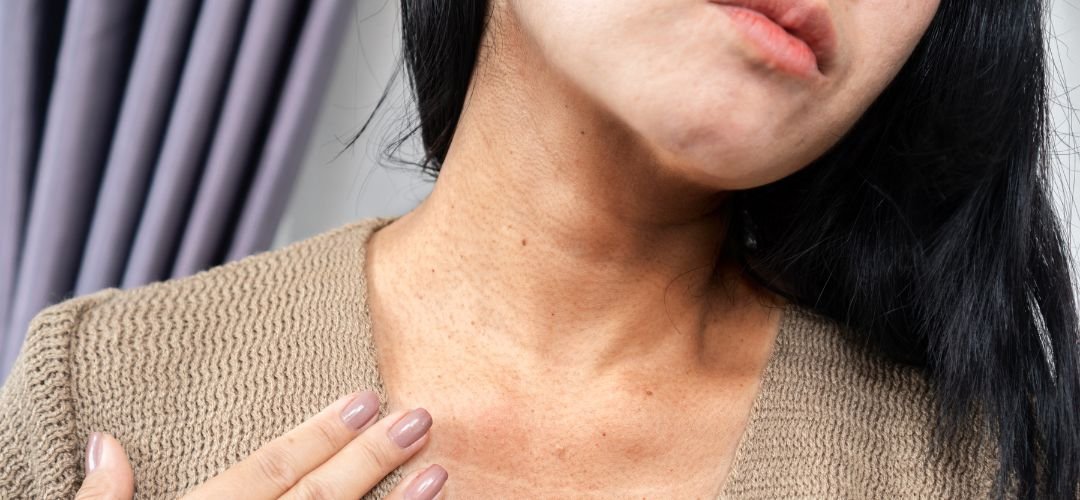
A few weeks ago, I posted a reel in which I applied my vaginal 0.01% estradiol cream to my neck, an off-label use I’ve been doing twice weekly for its impact on collagen, skin thickness, and hydration. Within hours, multiple viewers voiced the same worry: couldn’t that affect the thyroid gland sitting right there? It’s a great question, and the thyroid-estrogen connection deserves a real explanation, because thyroid conditions so often manifest or become harder to manage during perimenopause, exactly when many of us are reaching for estrogen in the first place.
So let’s break it down properly. There are really three separate questions tucked inside that one comment, and they have very different answers.
Can Local Estrogen Creams “Reach” the Thyroid?
The short answer: applying a local, low-dose estradiol 0.01% cream or a facial estriol cream to the neck will not deliver estrogen directly into the thyroid gland. The cream simply can’t tunnel down through skin, fat, fascia, and muscle into the glandular tissue beneath.
This isn’t hand-waving. It’s well-characterized skin pharmacology. After topical application, direct local penetration into the tissue beneath the application site is real but shallow: studies of topical drugs show direct penetration to a depth of only about three to four millimeters, with anything deeper arriving via the bloodstream rather than by burrowing straight down.¹ ² The thyroid sits well below that ceiling. It lies anterior to the trachea, covered by skin, subcutaneous fat, the platysma, fascia, and the strap muscles,³ and in clinical practice, thyroid nodules just nine millimeters deep are already considered “deep” enough to compromise needle biopsy.⁴ The gland is layered far beneath where any topical agent penetrates directly.
For this reason, I am no more concerned about applying these local, non-systemic estrogen formulations to the neck than I am about applying them anywhere else on the body when it comes to thyroid impact. The proximity is an illusion of risk, not a real one.
However, and this is the important pivot, estrogen can reach the thyroid through systemic circulation in the bloodstream. So any estrogen formulation that gets absorbed systemically, whether cream, gel, patch, or pill, does reach the thyroid the same way: through the blood. The question becomes, when and why does that matter? Let’s walk through the scenarios.
Scenario 1: Oral Estradiol and Thyroid Hormone Treatment
The most clinically important interaction is one that women with hypothyroidism on thyroid hormone therapy should know about: the effect oral estradiol has on thyroxine-binding globulin, or TBG.
TBG is a carrier protein produced in the liver. It binds circulating thyroid hormone, holding it in an inactive, “in transit” state.⁵ Here’s the catch with oral estrogen: because a swallowed pill is absorbed through the gut and routed straight to the liver first (the so-called hepatic first-pass effect), oral estradiol signals the liver to ramp up TBG production, raising levels by roughly 40%.⁶ ⁷ When estrogen raises TBG, more thyroid hormone gets bound up, transiently lowering free T4. That dip stimulates TSH, which drives the thyroid to produce more hormone until a new equilibrium is reached. In a woman with a normally functioning thyroid, this self-corrects automatically and invisibly. In a woman on levothyroxine, it doesn’t, because her dose is fixed and her gland can’t autoregulate to compensate. The result: her thyroid hormone requirement rises.⁶ ⁷ This is precisely why this subset of women often needs a levothyroxine dose increase, with careful monitoring, after starting oral estrogen, and why a TSH check a couple of months into therapy is the standard, sensible move.⁸
Now the part that matters most for our neck question: this is a route problem, not an estrogen problem. Topical local estradiol or estriol, as well as systemic transdermal estrogen (patches and gels), bypass the liver’s first-pass metabolism entirely. They do not meaningfully raise TBG, and so they don’t produce the downstream drop in free T4.⁸ ⁹ The transdermal route is, for this exact reason, often considered preferable in women who need estrogen alongside thyroid hormone therapy.⁹ A low-dose local cream sits even further down that spectrum of systemic exposure than a patch does.
Scenario 2: Estrogen Receptor Activity in the Thyroid Gland
Here’s where it gets genuinely interesting, and where I get the most nervous questions: the thyroid isn’t a passive bystander to estrogen. Thyroid cells carry estrogen receptors, and in the lab, estradiol can prod thyroid cells to proliferate through the same ERα-driven pathways that matter in breast tissue.¹⁰ ¹¹ This is particularly true of papillary thyroid cells.¹² That’s a real biological signal, and it’s part of why thyroid disease and thyroid cancer skew so heavily female. So the worry isn’t irrational: if estrogen makes thyroid cancer cells divide in a dish, shouldn’t we worry about feeding it more?
However, what plays out in a petri dish has not been shown to carry over to real women. A Women’s Health Initiative cohort of 145,000 postmenopausal women found no link between hormone therapy and thyroid cancer,¹³ and a meta-analysis pooling 25 studies came to the same conclusion: no increased risk.¹⁴ Some data even point the other way, with a French study finding HRT users had about a third lower risk of papillary thyroid cancer.¹⁵ But the picture isn’t uniformly spotless. One large NIH-AARP cohort did find a slightly elevated risk of thyroid cancer in current HRT users, but with no dose-response trend, meaning longer use didn’t raise the risk further, which is exactly the pattern you’d expect to see if the link were truly causal and exactly what you don’t see here.¹⁶ And estrogen-only therapy (not the combined estrogen-progestin kind) has been flagged in at least one review.¹¹ These are modest, inconsistent signals scattered against a much larger reassuring backdrop. The cellular plausibility is real; the population-level risk simply hasn’t reliably shown up. Importantly, no major guideline lists thyroid cancer as a reason to avoid HRT.
Now layer the neck question on top of that already-reassuring picture, and it gets even smaller. Even if estrogen could nudge a thyroid cell, your cream isn’t reaching the gland by sitting on your neck. The thyroid is buried under skin, fat, fascia, and muscle, far below the three to four millimeters that any topical penetrates directly. Whatever tiny amount of estradiol your gland ever “sees” arrives through your bloodstream, exactly as it would from a patch on your thigh. The skin you smooth it onto is incidental. The thyroid conversation is about route and dose, never about real estate.
Scenario 3: Autoimmunity and the Female Predominance Puzzle
Here’s the question that sits underneath all the others: women carry the overwhelming burden of autoimmune thyroid disease (Hashimoto’s and Graves’ run roughly five to ten times more common in women than men), so if you’re adding estrogen to a woman’s system, aren’t you pouring fuel on the very fire that’s already burning hotter in us? It’s a fair instinct. But the answer requires separating two things we tend to blur together: why women are more susceptible in the first place, and whether giving exogenous estrogen moves that needle.
Start with the “why,” because it’s more interesting than “estrogen did it.” Women represent about 80% of all people affected by autoimmune diseases¹⁷ and while sex hormones absolutely play a role, the newer and more compelling story is genetic. Every woman carries two X chromosomes, and to avoid a double dose of X-linked genes, one gets silenced in each cell through a process called X-chromosome inactivation. The catch: this silencing is incomplete, and somewhere between 15 and 23% of genes on the inactivated X chromosome escape it¹⁸, including immune-regulating genes like TLR7. The molecule that orchestrates the whole silencing process, Xist, has itself recently been implicated: the RNA-protein-DNA complexes formed during X-inactivation appear to trigger a strong immune response, and women with autoimmune disease carry autoantibodies against many of the proteins associated with Xist.¹⁹ In other words, a meaningful chunk of female autoimmune predominance is baked into chromosomes, not circulating hormones. The most elegant proof? Men with Klinefelter’s syndrome, who carry an extra X (XXY), develop autoimmune disease at rates that match women’s:²⁰ it tracks with the second X, not with being female.
Estrogen does contribute to that genetic substrate. Estrogen boosts the function of T and B immune cells, which helps women fight infection but can be problematic in someone already primed for autoimmunity.²¹ But here’s the detail that complicates the tidy “more estrogen equals more thyroid autoimmunity” logic: if it were that simple, autoimmune thyroid disease should fade after menopause when estrogen craters. It doesn’t. The prevalence of autoimmune thyroid disease, particularly Hashimoto’s, is noticeably higher in the perimenopausal and postmenopausal years, and the risk climbs with age.²² The female predominance even persists in childhood before puberty and in postmenopausal women when estrogen is low, which tells researchers that mechanisms beyond sex hormones are doing the heavy lifting.²³ Now, I want to be fair to the other side of this, because you’ve likely felt it or heard it: many women experience Hashimoto’s flares during perimenopause, and declining, erratically fluctuating estrogen is often blamed. Both things can be true at once. Estrogen and progesterone have genuine anti-inflammatory, immune-stabilizing effects, and losing that steadying tone during the menopausal transition can absolutely unsettle an already-primed immune system,²² while the deeper why-women-at-all driver remains genetic and age-related. Estrogen is a modulator riding on top of that story, capable of nudging symptoms in either direction depending on context. It is not the engine of the disease.
So does taking estrogen change a woman’s odds of developing autoimmune thyroid disease? The reassuring reality is that the thyroid-specific autoimmune signal simply hasn’t materialized in the data. (A large 2025 database analysis did make headlines suggesting hormone therapy users had somewhat higher rates of autoimmune disease generally, but it was a preliminary, not-yet-peer-reviewed retrospective study whose own authors urged caution, and notably, Graves’ disease was one of only two conditions that showed no increased risk, plausibly because Graves’ tends to develop earlier in life, between ages 30 and 50, so most postmenopausal women have already passed that risk window.²⁴) The takeaway isn’t “one study says relax.” It’s that there’s no consistent, credible signal that estrogen therapy triggers autoimmune thyroid disease.
And even setting all of that aside, the route-and-dose principle from the earlier scenarios reasserts itself one final time. Whatever immune-modulating effect circulating estrogen has, it depends on estrogen actually reaching circulation in a meaningful quantity. Because transdermal estrogen doesn’t alter binding globulins or thyroid function parameters the way oral estrogen does, the transdermal route is considered preferable in women who need estrogen alongside thyroid concerns,⁹ and a low-dose local cream sits even further down that spectrum than a systemic patch.
Which brings us, finally, back to the neck. Applying a local 0.01% estradiol or facial estriol cream to your neck will not raise your risk of developing autoimmune thyroid disease, and not because of where it lands. The female autoimmune predominance is overwhelmingly a story of two X chromosomes, Xist, and aging immunity; estrogen is a supporting player layered on top, the thyroid-specific autoimmune signal is reassuringly quiet, and a local cosmetic-dose cream delivers a vanishingly small systemic estrogen load regardless. The thyroid gland tucked beneath your neck doesn’t “see” the cream because of proximity any more than it sees the genetics that actually drive the disease. Once again: route and dose, never real estate.
The Bottom Line
Whether you apply your estrogen cream to your neck or your toes, it’s the estrogen circulating systemically that may interact with the thyroid. This reminds us yet again that estrogen creams are active hormones, not mere skincare; they have a real biologic impact on the body. The estrogen-on-the-neck story is reassuring; the estrogen-anywhere-that-impacts-systemic-levels story is what actually drives this conversation around thyroid health.
The easiest answer for anyone concerned is to simply not even think about putting estrogen on the neck, or anywhere off-label, for that matter. There are plenty of other topical creams and serums to help the skin. But if you are off-label estrogen inclined, then the data is very reassuring around the safety of topical estrogen formulations in general, even in the setting of thyroid disease and thyroid cancer. Oral estrogen introduces additional considerations due to first-pass hepatic metabolism and its impact on free T4 levels in the setting of hypothyroidism and levothyroxine treatment.
Whether estrogen cream on the neck will have any true benefit is another question entirely, and one that needs larger randomized, placebo-controlled trials to answer. For now, this perimenopausal dermatologist will keep applying a very small amount to her neck, along with her retinol, sunscreen, and make her best efforts to keep her head up while writing her Substack articles.
