
By Dr. Corinne Erickson, Board-Certified Dermatologist and Menopause Society Certified Practitioner | Clear Aesthetics MD, Atlanta, GA
"Protect what you have. Replace what you've lost."
This simple philosophy guides Dr. Corinne Erickson's approach to skincare at Clear Aesthetics MD in Atlanta.
Healthy skin isn't about stopping the aging process or chasing every new skincare trend. It's about understanding what your skin needs as it changes and choosing ingredients that protect against future damage while addressing the effects of aging and hormonal fluctuations.
From antioxidants and sunscreen to retinoids, topical estriol, and barrier-supporting moisturizers, a thoughtful skincare routine can help maintain healthier, more resilient skin at every stage of life.
What Is the Best Skincare Routine for Healthy Aging?
A dermatologist-recommended skincare routine for healthy aging should protect against UV damage, support collagen production, maintain hydration, and preserve the skin barrier.
Dr. Erickson's approach focuses on five key skincare ingredients and product categories.
Protect vs. Replace: The 5 Skincare Essentials
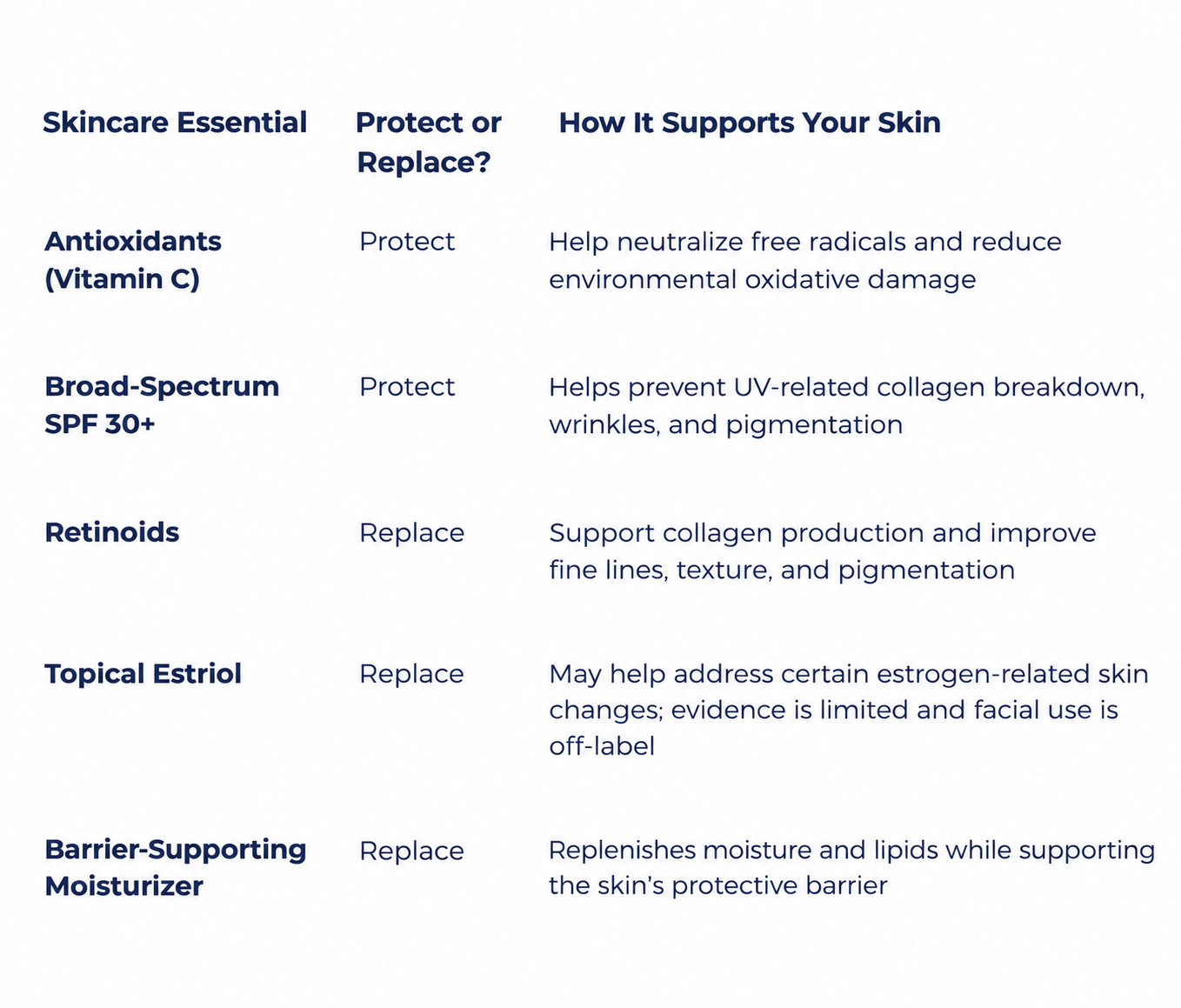
These ingredients serve different purposes, but they work toward the same goal: supporting healthy skin as it changes over time.
Protect What You Have: Antioxidants and Sunscreen
Protecting your skin starts with minimizing the damage that accelerates visible aging.
Two of the most important steps are antioxidant protection and daily sunscreen.
1. Why Are Antioxidants Important for Your Skin?
Topical antioxidants help protect the skin against oxidative stress caused by UV exposure, pollution, and other environmental factors.
Free radicals are unstable molecules that can damage skin cells and contribute to collagen breakdown, fine lines, wrinkles, and uneven pigmentation.
Antioxidants help neutralize free radicals and reduce oxidative damage.
One of the most researched topical antioxidants is vitamin C.
Benefits of vitamin C may include:
Helping protect against environmental oxidative stress
Supporting collagen synthesis
Improving the appearance of uneven skin tone
Reducing the appearance of certain signs of photoaging
Complementing daily sunscreen protection
Vitamin C is particularly useful in a morning skincare routine because it provides additional antioxidant support alongside sunscreen.
Other antioxidants, including vitamin E and ferulic acid, are often combined with vitamin C in skincare formulations.
Dr. Erickson's approach: Protect the collagen you already have before focusing on replacing what you've lost.
2. Why Is Sunscreen the Most Important Anti-Aging Skincare Product?
Daily broad-spectrum sunscreen with SPF 30 or higher is one of the most effective ways to prevent premature skin aging.
Ultraviolet radiation contributes to collagen breakdown, wrinkles, uneven pigmentation, and changes in skin texture.
UVA rays penetrate more deeply into the skin and contribute to photoaging, while UVB rays are a major cause of sunburn. Both can contribute to skin damage.
Daily sunscreen helps:
Protect existing collagen and elastin
Reduce the development of fine lines and wrinkles
Prevent worsening of sun-related pigmentation
Lower the risk of skin cancer
Preserve the benefits of other skincare products
And sunscreen isn't just for beach days.
UVA rays can penetrate window glass, meaning your skin may be exposed while driving or sitting near windows.
For daily use, choose a broad-spectrum SPF 30 or higher that you enjoy wearing consistently. Apply generously and reapply as appropriate, particularly during outdoor exposure.
The bottom line: You can invest in the best skincare ingredients available, but protecting your skin from UV damage remains essential.
Replace What You've Lost: Retinoids, Estriol, and Barrier Moisturizers
As we age, our skin experiences changes in collagen production, hydration, thickness, and elasticity.
During perimenopause and menopause, declining estrogen can contribute to additional changes in skin structure and function.
While no topical product can completely reverse biological aging, certain ingredients can help improve skin quality and address specific changes.
3. How Do Retinoids Help Restore Aging Skin?
Retinoids are vitamin A derivatives that help improve fine lines, uneven pigmentation, and skin texture while supporting collagen production.
Retinoids are among the most extensively studied topical ingredients for photoaging.
Depending on the formulation, they can help:
Stimulate collagen production
Improve the appearance of fine lines and wrinkles
Support skin cell turnover
Improve uneven pigmentation
Reduce acne and clogged pores
Improve overall skin texture
Prescription tretinoin has substantial clinical evidence supporting its effectiveness for photoaging.
Over-the-counter retinol and retinal products can also be useful, although their strength, tolerability, and clinical evidence vary.
Because retinoids may cause dryness and irritation, particularly when first introduced, it's important to start gradually and use a moisturizer that supports the skin barrier.
Retinoids are generally avoided during pregnancy.
Dr. Erickson's approach: Retinoids help address existing signs of aging while supporting the skin's ongoing renewal processes.
4. Can Topical Estriol Improve Menopause-Related Skin Changes?
Small studies suggest that topical estrogen may improve certain measures of skin hydration, thickness, elasticity, and collagen in postmenopausal women. However, evidence specific to facial estriol remains limited, and facial estrogen use is off-label in the United States.
Estrogen plays an important role in maintaining skin health.
As estrogen levels decline during perimenopause and menopause, women may notice:
Increased skin dryness
Thinner or more fragile skin
Loss of elasticity
More pronounced fine lines and wrinkles
Changes in skin texture
These changes are among those described by Pilocutaneous Syndrome of Menopause (PSM), an emerging clinical framework coauthored by Dr. Erickson that explores the relationship between hormonal changes and skin and hair health.
Dr. Erickson personally prefers an estriol formulation designed for facial application because of its texture and tolerability.
Estriol is a less potent estrogen than estradiol, but this does not establish that facial estriol products have negligible systemic absorption or are appropriate for everyone.
Research into topical facial estrogen is promising but still developing. Larger studies are needed to establish long-term safety, effectiveness, and optimal formulations.
Topical estriol is a hormone treatment. Facial use is off-label, is a prescription medication, and should be considered only under the guidance of a qualified prescribing clinician. Systemic estrogen gels should not be repurposed for facial application.
5. Why Does Aging Skin Need a Barrier-Repair Moisturizer?
Barrier-supporting moisturizers help replenish moisture, reduce transepidermal water loss, and support the skin's natural protective function.
As skin ages, changes in natural lipids and hydration can leave it feeling dry, tight, sensitive, or rough.
Hormonal changes during menopause may further contribute to dryness and impaired barrier function.
A moisturizer can help replace some of the moisture and lipids that skin struggles to retain.
Look for ingredients such as:
Ceramides: Help replenish lipids important for healthy barrier function.
Hyaluronic acid: Attracts and binds water to support hydration.
Glycerin: A humectant that helps draw moisture into the outer skin.
Cholesterol and fatty acids: Help support the skin's natural lipid barrier.
Petrolatum or other occlusives: Help reduce moisture loss.
A healthy skin barrier is also important when using active ingredients such as retinoids, which can cause irritation if introduced too aggressively.
Moisturizers don't replace lost facial volume or reverse every structural change associated with aging. They help restore hydration and support the skin's ability to function properly.
Dr. Erickson's approach: Healthy skin isn't just about stimulating collagen. It's also about maintaining the hydration and barrier function your skin needs.
How Do You Combine These Ingredients Into a Daily Skincare Routine?
A skincare routine doesn't need to be complicated to be effective.
For many patients, a morning routine focused on protection and an evening routine focused on renewal and hydration is a practical starting point.
Morning Routine: Protect What You Have
Gentle cleanser: Cleanse without stripping the skin.
Antioxidant serum: Apply vitamin C or another appropriate antioxidant formulation.
Moisturizer: Support hydration and barrier function as needed.
Broad-spectrum SPF 30+: Protect against daily UV exposure.
Evening Routine: Replace What You've Lost
Gentle cleanser: Remove sunscreen, makeup, and daily buildup.
Retinoid: Apply an appropriate retinoid to address texture, fine lines, and collagen loss.
Topical estriol, when prescribed: Follow your clinician's instructions for application and timing. This is off-label use.
Barrier-supporting moisturizer: Help replenish hydration and reduce irritation.
Not every patient needs all five ingredients. Topical estriol is not a routine recommendation for everyone, and retinoid frequency should be adjusted to individual tolerance.
Your dermatologist can help determine which products are appropriate and how to layer them.
What Skincare Ingredients Are Most Important During Perimenopause and Menopause?
During perimenopause and menopause, skincare routines may need to place greater emphasis on hydration, barrier repair, collagen support, and sun protection.
Estrogen fluctuations and decline can affect the skin's ability to retain moisture and maintain collagen.
For some women, products that worked well in their 30s may suddenly feel too drying or irritating.
A thoughtful skincare routine may include antioxidants and sunscreen to prevent additional damage, retinoids to address photoaging, and richer moisturizers to support a changing skin barrier.
For selected patients, a dermatologist may also discuss the emerging evidence surrounding topical facial estrogen.
The goal isn't to use more products. It's to understand why your skin is changing and choose ingredients that address those changes.
Frequently Asked Questions About Anti-Aging Skincare
Should I use vitamin C or retinol for aging skin?
Vitamin C and retinoids serve different purposes. Vitamin C provides antioxidant protection and may help improve uneven tone, while retinoids support collagen production and improve fine lines and texture. Many people benefit from using vitamin C in the morning and a retinoid at night.
Can I use retinol and estriol together?
A clinician may prescribe facial estriol alongside a retinoid, but combining them should be individualized. Both formulation and skin tolerance matter, and evidence on the combined use of these ingredients remains limited.
What is the best moisturizer for menopausal skin?
A moisturizer containing ceramides, glycerin, hyaluronic acid, and other barrier-supporting ingredients can help address dryness associated with menopause. The ideal formulation depends on your skin type and sensitivity.
Can skincare products rebuild lost collagen?
Certain retinoids have evidence supporting increased dermal collagen and improvement in photoaging. However, topical skincare cannot completely restore all age-related structural changes or reverse biological aging.
Do I need sunscreen if I use vitamin C?
Yes. Vitamin C complements sunscreen but does not replace it. Broad-spectrum sunscreen remains essential for protection against UV-related skin damage.
Is topical estriol the same as hormone replacement therapy?
Topical facial estriol is a hormone-containing treatment, but it is not equivalent to systemic menopausal hormone therapy. Absorption and effects depend on the formulation, dose, and application site. Facial use remains off-label in the United States.
Healthy Skin Starts With a Smarter Skincare Routine
The most effective skincare routine isn't necessarily the one with the most steps or the most expensive products.
It's the one that addresses what your skin actually needs.
At Clear Aesthetics MD, Dr. Corinne Erickson's philosophy is simple:
Protect what you have. Replace what you've lost.
Protect your existing collagen and skin health with antioxidants and daily SPF. Address age-related changes with evidence-based retinoids, barrier-supporting moisturizers, and individualized treatment options when appropriate.
By focusing on prevention and thoughtful replenishment, you can build a skincare routine that supports healthy skin at every stage of life.
Build a Skincare Routine That Works for You
Ready to put Dr. Erickson's philosophy into practice?
Whether you're looking to protect your skin with antioxidants and SPF or address changes in collagen, hydration, and skin texture, the right skincare routine starts with understanding your skin's unique needs.
Not sure where to start? Book a complimentary skincare consultation with the Clear Aesthetics MD team for personalized product recommendations, or try our 2-minute Skincare Regimen Builder to discover skincare products tailored to your concerns.
Book a Complimentary Skincare Consultation
This article is for educational purposes only and does not constitute medical advice. Prescription skincare and hormone-containing treatments should be discussed with a qualified prescribing clinician. Facial estriol use is off-label in the United States. Individual results vary.