
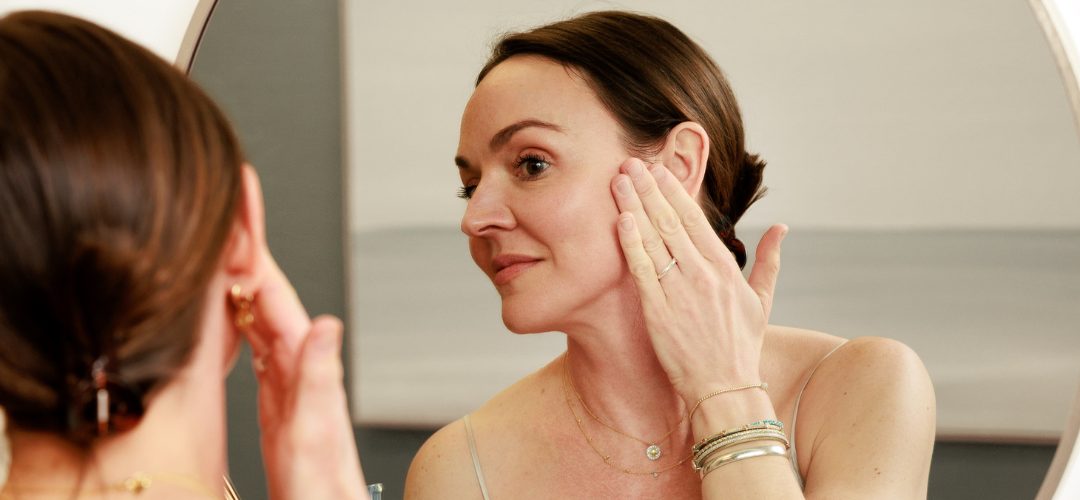
By Dr. Corinne Erickson x Hot Pause Health
Here’s the truth we don’t say loudly enough: When you hit perimenopause, your hormones are different, your skin is different, and your skin care needs to be different too.
If perimenopause finds you facing wrinkles, acne, discoloration, redness, irritation, flaking, and sagging that has you on high alert, take a breath. Your skin isn’t broken and neither are you. Your skin is just sending some pretty visible signals that its needs have changed and it’s time for you to change with it and give it what it actually needs now. The goal remains protection and prevention, but the strategy shifts toward repair, regeneration, and barrier restoration. Let’s break perimenopause skin care down so you can start building your skin health, and your glow, back up.
But First, Biology.
Ever wonder why men seem to age so gradually while women fall off an aging cliff? That’s the impact of estrogen, that goddess of a hormone that imparts hydration, structure, blood flow, and balance to our skin before she sputters like an emptying gas tank (perimenopause) and then just disappears (menopause.) She loves us and then she leaves us. Meanwhile, men just coast along since their aging process is not so estrogen dependent. Hence the sagging, sinking, and crinkling that comes from loss of collagen, elastin, and hyaluronic acid. It’s the midlife birthday present that didn’t come with a gift receipt.
When we talk about aging, we usually divide it up into “Intrinsic Aging” which includes genetics/epigenetics, and hormones and “Extrinsic Aging,” which includes UV exposure, environmental pollution, crappy American Diet, alcohol, and smoking. Intrinsic aging has generally been viewed as beyond our control and written in our stars, or possibly in our pores in this scenario. Extrinsic aging, on the other hand, is something we can modify with prevention and correction strategies.
The return of menopause hormone therapy to the scene after a 23 year hiatus spurred by the very flawed WHI data in 2002 is shifting the way we think about intrinsic aging. No longer are our hormones “beyond our control.” We understand (again for some and for the first time for most) that we can and should not let estrogen entirely leave. Women need her for optimal body functioning, not just for reproduction. Bones, muscles, brain, heart, gut, liver, and SKIN are all rich with estrogen receptors that help them function better. While hormone therapy is beyond the scope of this article, I want to ensure she gets a strong shout out as a key player in female longevity and skin health when safe and appropriate.
What Do We Wear (on our Skin) in Perimenopause and Menopause?
Just like we don’t wear the clothing we did in our teens and twenties, although I recently bought an outfit that I swear Alicia Silverstone wore in Clueless, we need to shift our skin care.
I’m going to break this down so even your worst brain fog day won’t be an issue. Been there, I’ve got you.
If you only remember two things, it’s protect in the morning and repair at night. Let’s break it down.
Morning Musts: Sunscreen with a side of….Orange Juice?
Yes, sunscreen is still non-negotiable. But in midlife, SPF alone isn’t enough.
Think of Vitamin C serums as SPF’s best friend. All day long, your skin is under an oxidative damage attack due to pollutants and UV exposure. SPF works hard against the UVB and UVA, but she needs a good wingman to handle the other free radicals that are like skin shrapnel, busting up your collagen and elastin, stimulating pigment release, triggering flushing and blushing, and cracking into your cellular DNA. Antioxidants like Vitamin C are the ideal wingman to layer on first before your SPF every morning. They neutralize free radicals that sunscreen can’t fully block, boosting overall protection and helping with brightness and collagen support.
Daily AM must-haves:
Medical-grade Vitamin C / antioxidant serum: Look for L-ascorbic acid or tetrahexydecyl ascorbate (THD).
SPF 30+, preferably tinted for added blue-light protection
Quality matters here- medical grade antioxidants serums are more stable (and more expensive), but it’s a skinvestment your skin will thank you for.
Sleeping on the Job: Products that Repair while you Rest
As estrogen declines, skin cell turnover slows, inflammation rises, and the barrier becomes more fragile. This is where regenerative skin care shines, especially while you sleep. Every cell in our body operates on a circadian rhythm. At night, our skin shifts into repair mode, so we fuel that effort with products that support skin cell turnover, DNA repair, and restoration. Conveniently for me who loves alliteration, the restoring, repairing and rejuvenation superstars also start with an “r.” Retinoids.
Retinoids like prescription tretinoin still reign as the gold standard for topically treating sun damage and wrinkles. But the aggressive formulas from your teens and 20’s? Not so much.
Give your teen his tazorac back. Return his Retin-A. There are better formulations for you and your purposes, and yes, they help the perimenopausal acne you may be experiencing too.
Retinols, retinals, retinyl esters, and retrinal are milder forms of retinoids. These are all vitamin a derivatives that interact with our skin cells to promote turnover, stimulate collagen, crank of DNA repair enzymes, and reduce sebum production. It’s that last superpower that can leave your skin dry, so going milder with these other options is often the best path, especially when starting a retinoid anew.
Even with an over the counter retinoid, I recommend going slowly, starting three nonconsecutive nights a week, then gradually increasing if possible to every night. If you can’t get past 3, that’s OK. That’ will make a difference. I’d rather it be three than five and too dry. For super sensitive skin, which estrogen deficiency can create, moisturize BOTH before and after the retinoid application.
Your 5 Star Bedtime Skin Routine:
Formulations with retinol, retinal, or retinyl esters which are available in OTC and medical grade products at least 3 nights per week.
Moisturizer with hyaluronic acid, glycerin, and or ceramides to minimize water loss.
Dr. E’s Favorite Retinoid: My favorite starter retinoid is Hydrinity’s Retaxome—hydrating, pore-refining, and well tolerated if you’ve struggled with retinoids before.
Dr. E’s Favorite PM Moisturizers (She uses Epionce Intense Nourishing Cream.
If you are new to the skin care game or just want the essentials, you’ve done your required reading and can go to counting your protein consumption. If you want more help for targeting issues like hormonal acne and hair loss, keep reading.
Toners & Exfoliation: Less Burn, More Balance
Midlife skin doesn’t like being bullied. Traditional toners rely on salicylic acid to degrease the skin, but in perimenopause, this can cause excessive dryness. Since acne is a very common perimenopause problem, there is still a place for the RIGHT toners in your regimen either daily or on an as needed basis. Shift your thinking around toners from something that strips your skin of oil to a treatment that restores the skin’s healthy acidic pH. Toners are usually the thinnest product in your regimen and should be applied immediately after washing and drying.
What to Set Aside:
Salicylic acid overload (No more SeaBreeze Please!)
Anything you used in high school. You deserve better.
What to Reach For Instead:
Hypochlorous acid (calms bacteria + inflammation)
Gentle AHAs like glycolic or mandelic acid for smoother texture without irritation
Dr. E’s Favorite Toner for Perimenopause/Menopause:
Hydrinity Hyacyn Active Mist: Apply AM and PM immediately after washing and drying face. Active ingredient - Hypochlorous acid. Great for sensitive skin with tendencies toward dryness, irritation, rosacea and/or acne. Restores skin pH, kills problematic bacteria, strengthens skin barrier.
Remember, even acne-prone skin usually does better with gentle, consistent exfoliation than harsh stripping. Oil is not the problem. Trapped oil and the aftermath are the issues.
Eyes Need Strategy (Not Slathering)
Yes, now that you are in perimenopause, you actually do need an eye product. The eyelid area is delighted to sell you out for a bad night’s sleep, salt or alcohol intake, and dehydration by getting puffy, dark, red, and crepey. It’s like they’re judging you or something. While and eye cream won’t correct the insomnia impact, the good ones will keep the barrier smoother, reduce edema, and fade discoloration. So eye products matter more than ever, but thicker is not better.
Slower cell turnover + heavy creams = milia city. For those yet to be acquainted with milia, they are tiny hard white bumps that form due to occluded oil glands, they love the eye area, and no you can’t pop them yourself.
Pro tips:
Use targeted, lightweight eye products
Apply sparingly
Let absorption happen before layering makeup
Dr. E’s Favorite Eye Product for Perimenopause/Menopause:
Hydrinity Eye Renew Complex: I call this the 4-in-1 because it tackles puffiness, vascular congestions (goodbye purple circles), pigmentation, and crepiness. Use twice daily on upper and lower lids.
Neocutis Lumiere Riche/Riche Firm: This is for dry, wrinkly crinkly skin to boost and smooth with rich emollients and growth factors.
Neck & Décolleté: Don’t Skip South of the Chin
I hear all the time: “I woke up and my neck looks old!” When the neck decides, to go, it goes fast and it releases no prisoners. The chest usually is a slower decline with sun damage that builds over the years, but the neck and it’s reliance on elastin fibers causes it to crash, and fast. Ideally you have been treating your neck and chest just like your face with SPF and skin care since your teenage years, but even I didn’t do that and I’m a Dermatologist. You don’t necessarily need a special cream that says “neck” on it though. Just choose the right products and treat everything from the chest up like you treat your face. it’s exposed, SPF goes down to your bra line—every single day.
At night, your neck deserves the same care as your face:
Retinoids (gentle)
Products that boost collagen and elastin
Rich moisturizers to support thinning skin
Dr.E’s favorite Breast Line up to Hair Line Products:
Retinoids: Hydrinity Retaxome and Revision DEJ Night
Non-retinoids (Great options to layer with a retinoid product, or use alone if you are retinoid hesitant on these areas):
Revision DEJ Boosting Serum and Hydrinity Renewing Serum
Your neck often shows hormonal aging first—treat it like the VIP it is.
Skin Is a Full-Body Organ (Yes, Really)
Most of your skin isn’t facial—and perimenopause shows up everywhere. If you take off your black pants and the insides looks like a snow flurry, read on.
Body Care Upgrades: Simple, FREE shifts that cost nothing but offer a big pay off
Swap harsh body washes for gentle, hydrating cleansers
Look for colloidal oatmeal to soothe and repair
Take a “Pits and Privates” approach to soaping up and spare the legs, arms, and torso most days.
Moisturize right after showering.
Dr. E’s favorite Body Wash for Dry, Irritated Skin
Dr. E’s favorite Body Moisturizers:
Hydrinity Encore: This one passes the yoga pants test. It’s not sticky, relieves itchy skin, and hydrates like that’s it’s job. Well, it is it’s job.
Isdin Uradin: This body moisturizer contains 10% Urea, an enzyme that enzymatically dissolves dry skin flakes. If you would ever use crusty or flaky to describe your skin, choose this one.