
Minoxidil for Women: Best Swallowed or Applied?
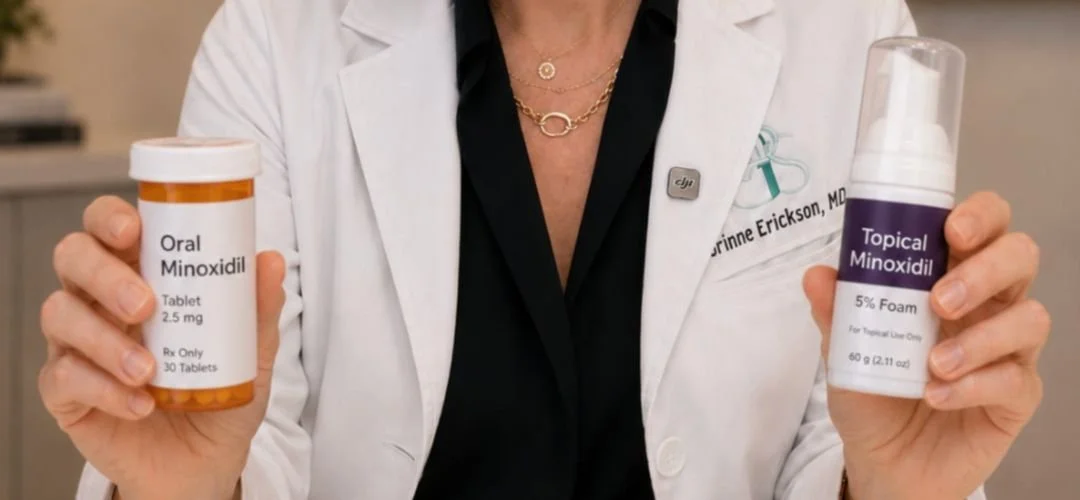
I’ll never forget the day that the New York Times article about the old medication that could treat hair loss for pennies a day came out. My phone blew up for weeks with screenshots of the headlines followed by some version of “Will this work for me?”
It was 2022, and I had never written a prescription for oral minoxidil. Why would I? Topical minoxidil worked, was relatively inexpensive, and tolerable. Along with other Dermatology colleagues, I found the New York Times article somewhat irksome. There had not been any new study findings showing the superiority of oral minoxidil to topical minoxidil that earned this old drug new notoriety. It had just been hiding in plain sight, waiting for someone to notice.
Over the weeks and months that followed, I became very comfortable prescribing oral minoxidil to patients. Of course, as luck would have it, one of my first patients experienced a rare but real anaphylactic reaction to it. I grumbled, “This never happened with topical minoxidil.” But whenever I had recommended topical minoxidil, the patients were the ones grumbling.
“What else is there?” Men and women alike asked. “It’s too messy,” women complained. “I can’t remember to apply it consistently,” said almost everyone.
If few people were excited to apply topical minoxidil before the NYT headlines, almost no one wanted it when they learned there was an oral option promised at pennies a day.
So here we are, almost 4 years into my routine prescribing and now taking of low-dose oral minoxidil for hair loss, and I’ve learned a lot in this time on both sides of the prescription bottle.
First, let’s talk about what the studies comparing oral and topical minoxidil show for female pattern hair loss. When used consistently, there has not been a statistically significant difference in efficacy between 5% foam (on label for FPHL) once daily and low-dose oral minoxidil daily. In the randomized trial that put low-dose oral minoxidil on the map for women, 1 mg daily went head-to-head against topical 5% applied once daily for 24 weeks, and hair counts improved similarly in both groups. No, the pill does not outperform the topical in studies when the topical is used as indicated, daily. Both show hair regrowth in about 50% of patients, which matches the original FDA registration trials for topical minoxidil, where more than half of women had regrowth by 48 weeks. So if you are looking at efficacy alone, and you will use the topical minoxidil consistently, the pill and the topical offer fairly equivalent benefit.
That last part is key though. Compliance with daily application of minoxidil 5% foam is poor due to the sticky, messy nature. Women who don’t wash their hair every day don’t like the residue, and it can cause scalp irritation (although less so than the solution formulation, which contains propylene glycol, a common contact allergen the foam leaves out). And if you don’t use it regularly, then the efficacy may falter.
Topical and oral minoxidil do differ in side effect profiles. The main side effects of topical minoxidil are irritant/contact dermatitis and hypertrichosis, or excess hair growth, on the face. In the head-to-head trial, scalp itching affected about 19% of the topical group, and facial hypertrichosis just 4%. The latter occurs when the product migrates from the scalp to the face, or transfers from unwashed hands. Oral minoxidil also causes hypertrichosis, but it’s not limited to the face, as the impacts are systemic, and it is far more common: 27% of women on 1 mg daily in that same trial, nearly seven times the topical rate. It is also dose-dependent. In the companion trial of men taking 5 mg daily, hypertrichosis hit 49%. Personally, I have to shave my legs more, and dermaplane my face at regular intervals since starting LDOM.
Oral minoxidil can also lower blood pressure, although the doses used in cardiology are much higher than those prescribed for hair loss. At 1 mg daily, the women’s trial found no significant blood pressure changes and a modest bump in heart rate of about 6%, without palpitations. It can cause peripheral edema, which is swelling of the extremities, and affected about 4% of women in the trial; headaches, and, rarely but as I can attest to, possible severe allergic reactions.
Both oral and topical minoxidil can cause the “dread shed,” the well-publicized increase in hair shedding for the first 1-2 months of minoxidil treatment. Studies have not shown a significant difference in shedding between the pill and the topical, and some suggest slightly more with the topical. The dread shed is actually a cause to celebrate as it signals new anagen hairs coming forth, but to a woman already panicked she is going bald, it can lead to immediate abandonment of treatment if she isn’t warned first.
Outside of my early allergic reaction issue with oral minoxidil, most conversations around side effects involve mustache management, as well as other facial hair concerns. These conversations have varied from a woman jumping for joy as she told about how happy she was that she had to shave her forehead because her hair was so thick, to a woman more bothered by the increase of facial hair than her prior scalp hair loss.
Promoting hair growth and stopping hair loss with any form of minoxidil doesn’t come without trade-offs, and as with most things in medicine, it is an art as much as it is a science.
There are ways of managing minoxidil’s side effects. I’ll often start a low dose of spironolactone alongside oral minoxidil for women who are very concerned about hypertrichosis, as it does minimize the facial hair growth. Androgen blockers finasteride and dutasteride have not been shown to work as well for this purpose, and must be limited to women without reproductive potential due to teratogenicity.
While the headlines from 2022 did not communicate the nuance of low-dose oral minoxidil prescribing, it did push the specialty of dermatology to learn how to prescribe and manage it in our patients. The demand and interest have continued to swell, as hair loss causes as much distress as other chronic illnesses.
As for this perimenopausal dermatologist with both a bottle of minoxidil 5% foam and prescription LDOM pills in her bathroom, I’ll tell you I’m still a little conflicted about which path is best for me to take. I am currently taking the oral minoxidil, and thankfully I’m good with a pair of tweezers and have access to dermaplaning, but every time I get a headache or my blood pressure drops low, I wonder if it’s related, and if so, if it’s worth it.
The great news for women is that this is being studied, we do have options, and either the oral or topical generic versions should run you well under a dollar per day. As the chart below shows, the same molecule can cost anywhere from $2 to $90 a month depending on which door you walk through. Generic oral minoxidil with a pharmacy coupon runs $2 to $14 a month depending on your dose. Generic topical foam runs $8 to $15. Branded Rogaine, $11 to $21 depending on pack size. Telehealth subscriptions start at $29 for the identical pill. You can spend more if you want. There are plenty of enterprising compounding pharmacies that will sell it to you for up to $90 a month, but please, if you learn nothing else from this article, don’t fall for that.
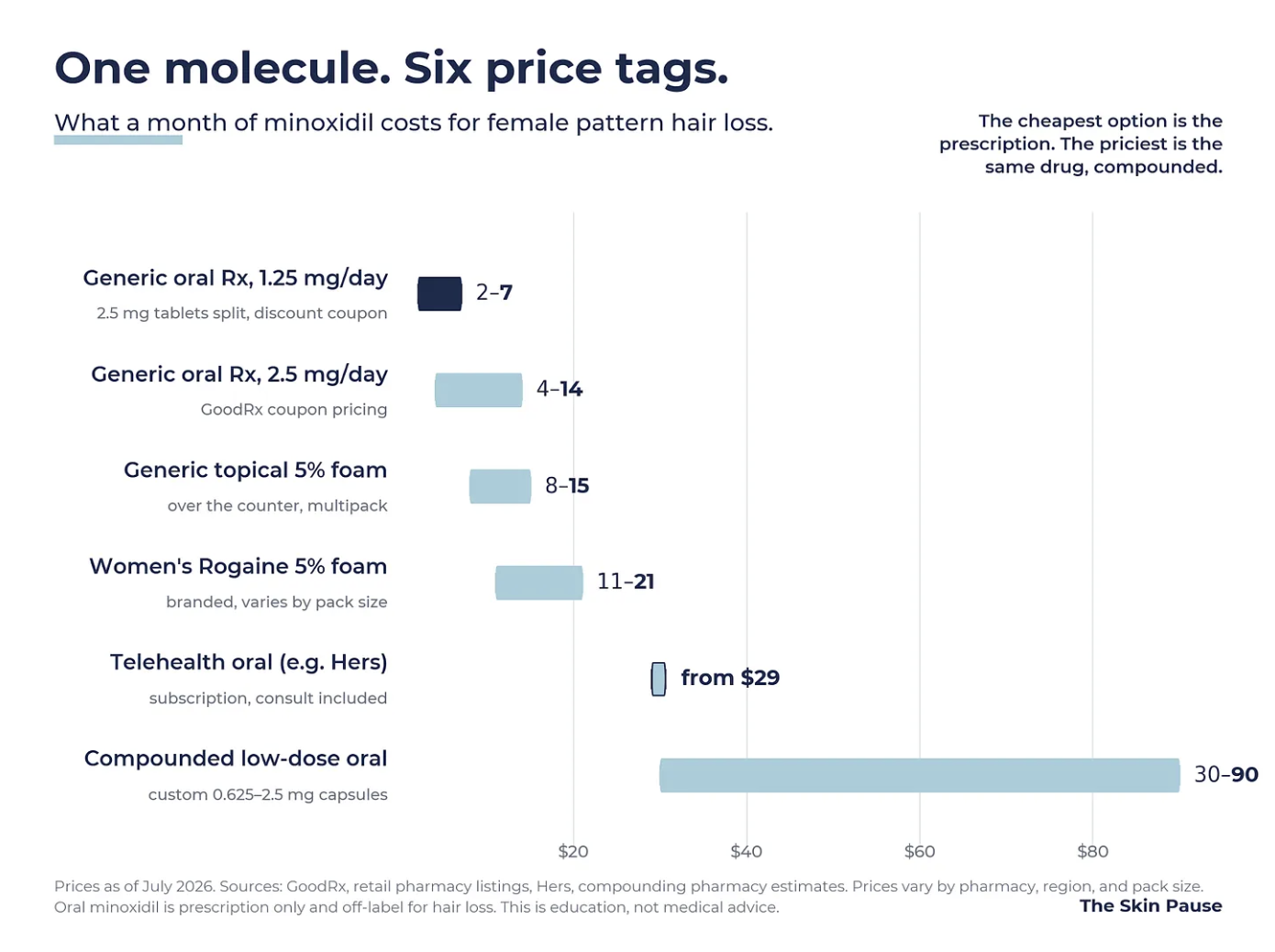
What a month of minoxidil actually costs, July 2026. Same molecule, six price tags.
As for the author of the 2022 New York Times Minoxidil article, thank you for making waves in medicine and pushing dermatologists to learn how to teach this old dog a new trick. Now, when you have time, can you do the same for vaginal estradiol?

Education, not medical advice. Treatment recommendations should always be individualized with your healthcare provider.